The Badlands East of Rapid City
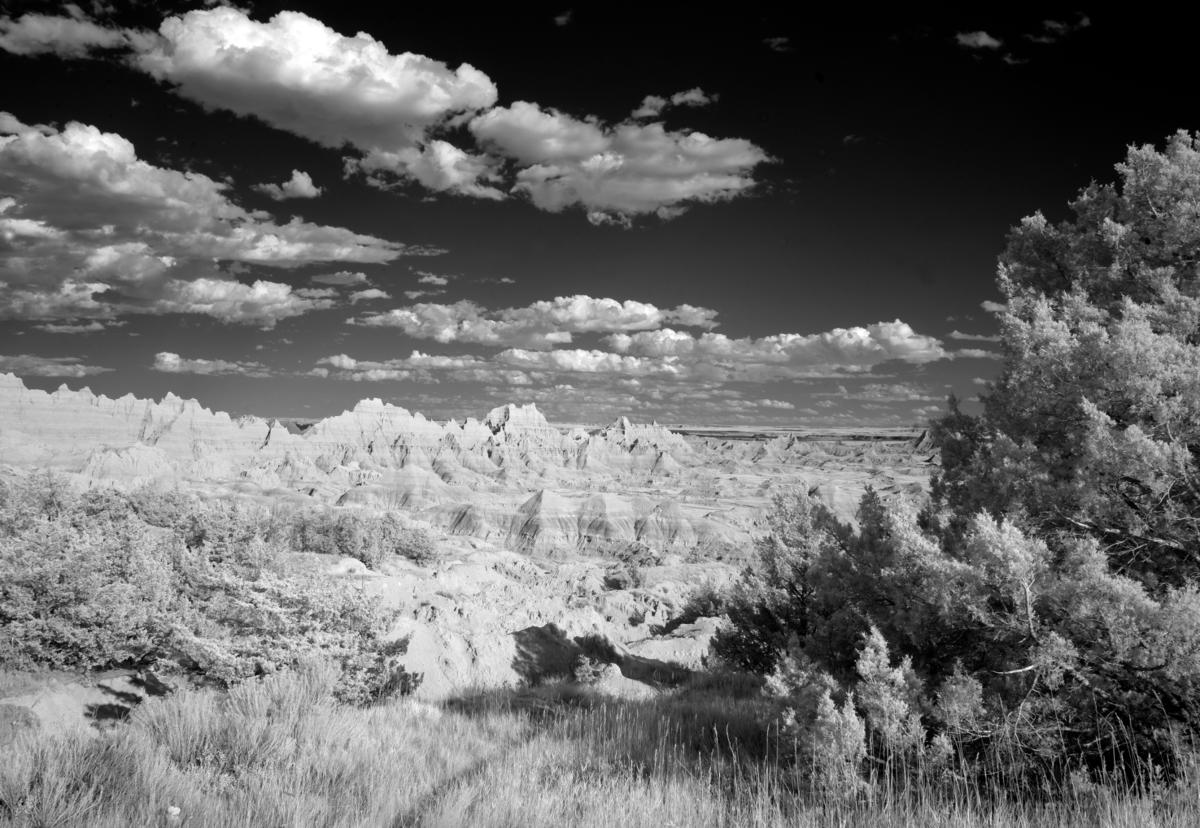
Drive east from Rapid City across the high prairie and the land seems unbroken, a wide expanse of grass running flat to the horizon under a very large sky. Then, with little warning, the ground falls away. The grassland breaks at the edge of a great trench of bare, banded rock, a maze of buttes, spires, ridges, and gullies carved into pale and rusty layers, stretching for miles with the green prairie continuing on the far side. The contrast is abrupt and startling, and it explains the name that travelers and Native people alike gave the country: land hard to cross, bad lands.
The Lakota called the region by a name meaning roughly the same thing, mako sica, difficult country, and the early French travelers translated the idea into their own tongue. The name was a practical judgment as much as a description. The eroded ground is broken, steep, and short of water, hard on horses and wagons and easy to get lost in, the kind of country a traveler crossing the plains would rather go around than through. Yet the same erosion that made it difficult also made it revealing, stripping away the surface to expose what lay beneath.
What the rock records
The banded walls of the Badlands are a record of deep time laid bare. The layers were deposited over millions of years, sediments built up when the region held very different environments, and they have been eroding away only recently in geological terms, the soft rock cut rapidly by water and weather. That erosion exposes one of the richest fossil records of its kind anywhere. The beds preserve the remains of creatures that lived long after the great dinosaurs, mammals of an ancient world, and for well over a century scientists have come to the Badlands to read that record in the rock. Fossil hunting in the region goes back to the early days of American paleontology, and the area remains an important place for the study of the deep past.
The erosion that exposes the fossils is also slowly destroying the formations themselves. The Badlands are wearing away faster than most landscapes, the soft sediments yielding to every rainstorm, so that the buttes and spires are not permanent features but a passing stage in a long process. Given enough time, the whole eroded zone will continue to retreat and reshape itself, the prairie above slowly consumed at its edge. What a visitor sees is a moment in that ongoing work, a landscape caught in the act of coming apart.
A protected landscape
The most striking stretches of the country were set aside for protection, eventually becoming a national park unit east of Rapid City. The protected lands hold not only the eroded rock and the fossil beds but also a substantial expanse of mixed-grass prairie on the tablelands above, home to bison, pronghorn, and prairie dogs, with bighorn sheep picking their way along the cliffs. That combination, the dramatic broken country and the surrounding grassland, preserves both the spectacle and the living prairie ecosystem in which it sits.
The Badlands also carry a heavy human history. The country lies near the Pine Ridge Reservation and the lands of the Oglala Lakota, and the broader region was the setting for some of the final, tragic chapters of the conflict on the plains, including the events surrounding the Ghost Dance movement and the killings at Wounded Knee. A portion of the park lies within the reservation and is managed in cooperation with the tribe, so that the protected landscape holds Lakota history and presence as well as fossils and scenery.
For travelers, the Badlands often serve as a companion to the other sights of the region, lying along the route between the Black Hills and the east, near the preserved Minuteman missile site that tells a very different story of the same prairie. The two landscapes sit close together, the ancient eroded rock and the Cold War silos, each in its way a record of time written into the plains. The Badlands offer the older and stranger of the two, a place where the grassland suddenly gives out and the earth shows its long history in bare, banded stone.